
Mastering your finances starts with understanding where your money goes. Expense tracking, while seemingly tedious, unlocks the pathway to informed budgeting and achieving your financial goals. This guide provides practical strategies and tools to simplify the process, transforming expense tracking from a chore into a powerful tool for financial empowerment.
From choosing the right method – be it spreadsheets, budgeting apps, or even a trusty notebook – to analyzing your spending habits and setting realistic budget goals, we’ll cover it all. We’ll explore advanced techniques like zero-based budgeting and offer tips on maximizing savings. Prepare to gain control of your finances and build a brighter financial future.
Analyzing Your Expenses for Better Budgeting Decisions
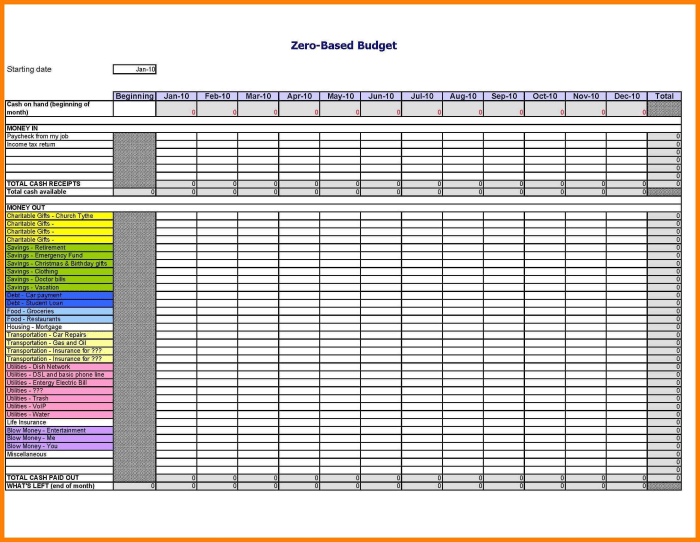
Understanding where your money goes is crucial for effective budgeting. Analyzing your expense data allows you to identify spending patterns, pinpoint areas of overspending, and make informed decisions to improve your financial health. This process involves more than just looking at your bank statements; it requires a systematic approach to uncover insights and guide your budgeting strategy.Analyzing expense data involves categorizing your spending and comparing it against your income and budget goals.
This can reveal imbalances between your spending habits and your financial objectives. Effective analysis allows you to identify areas where you can cut back or reallocate funds to achieve your financial targets. For example, you might discover that dining out constitutes a significant portion of your expenses, prompting you to explore cost-effective alternatives like home-cooked meals.
Visualizing Expense Data
Visual representations of your spending significantly enhance understanding and facilitate decision-making. Charts and graphs provide a clear and concise overview of your financial data, making it easier to spot trends and anomalies. Methods such as bar charts, pie charts, and line graphs can effectively communicate your spending patterns over time or across different categories. For instance, a pie chart can visually represent the proportion of your income allocated to various expense categories, highlighting areas where spending is disproportionately high.
A line graph can illustrate spending trends over several months, revealing seasonal fluctuations or consistent patterns.
Creating a Simple Bar Chart
To illustrate, let’s create a hypothetical bar chart depicting monthly spending across different categories. The chart will represent spending for the month of July. The horizontal axis (x-axis) will represent the different spending categories: Housing, Transportation, Food, Entertainment, and Other. The vertical axis (y-axis) will represent the amount spent in each category, measured in dollars.The data for the chart would look like this:| Category | Amount Spent ($) ||—————–|——————-|| Housing | 1500 || Transportation | 300 || Food | 600 || Entertainment | 200 || Other | 400 |The bar chart would then visually represent this data.
Each category would have a corresponding bar, with the height of the bar proportional to the amount spent. For example, the “Housing” bar would be the tallest, reflecting the $1500 spent. The “Entertainment” bar would be the shortest, reflecting the $200 spent. Clear labels on both axes would ensure easy interpretation. The title of the chart would be “July Monthly Expenses.” This visual representation makes it immediately clear which expense categories are dominant and where potential savings might be found.
Setting Realistic Budget Goals and Sticking to Them
Creating a budget that truly works requires setting achievable goals and developing strategies to maintain financial discipline. A well-structured budget isn’t about drastic cuts; it’s about mindful spending and aligning your financial habits with your overall objectives. This involves a realistic assessment of your income and expenses, followed by the development of a plan that allows for both necessary spending and the pursuit of your financial goals.Setting realistic budget goals involves understanding your current financial situation and projecting your future needs.
Avoid overly ambitious targets that are likely to lead to discouragement and abandonment of the budget altogether. Instead, focus on small, incremental changes that build towards larger financial improvements over time. For example, instead of aiming to save $1000 a month immediately, start with a more manageable $100 and gradually increase this amount as you gain confidence and see progress.
Strategies for Staying Within a Budget
Maintaining a budget requires consistent monitoring and proactive adjustments. Regular review of your spending habits, coupled with effective strategies for managing unexpected expenses, is crucial. Tracking your spending against your budget regularly, perhaps weekly or bi-weekly, allows you to identify areas where you’re overspending and make necessary corrections. Setting up automatic transfers to your savings account can ensure consistent progress towards your savings goals.
Furthermore, establishing an emergency fund to handle unforeseen expenses helps prevent derailing your budget when unexpected events occur. For example, having $1000 in an emergency fund can cover minor car repairs or unexpected medical bills without significantly impacting your savings or other budget allocations.
Managing Unexpected Expenses
Unexpected expenses are an inevitable part of life. Having a plan in place to address these situations is key to maintaining a stable budget. Building an emergency fund, as mentioned previously, is a critical first step. This fund should ideally cover 3-6 months of essential living expenses. Additionally, regularly reviewing your insurance coverage – health, auto, home – can help mitigate the financial impact of unexpected events.
It’s also helpful to prioritize expenses and identify areas where you can cut back temporarily if an unexpected expense arises. For instance, temporarily reducing dining out or entertainment expenses can free up funds to cover an unexpected repair bill without jeopardizing long-term savings goals.
The 50/30/20 Budgeting Rule
The 50/30/20 rule is a simple yet effective budgeting guideline that categorizes spending into three main areas: needs, wants, and savings. This rule suggests allocating 50% of your after-tax income to essential needs (housing, groceries, transportation, utilities), 30% to wants (entertainment, dining out, hobbies), and 20% to savings and debt repayment. For example, if your monthly after-tax income is $3000, you would allocate $1500 to needs, $900 to wants, and $600 to savings and debt repayment.
This rule provides a framework for prioritizing essential expenses while still allowing for discretionary spending and financial planning. It’s important to remember that this is a guideline, and the percentages can be adjusted based on individual circumstances and financial goals. For example, someone with significant student loan debt might allocate a larger percentage to debt repayment, even if it means reducing the allocation to wants.
Effective expense tracking is not just about monitoring spending; it’s about gaining a comprehensive understanding of your financial landscape. By implementing the strategies and tools discussed, you can move beyond simply tracking expenses to proactively managing your money. This empowers you to make informed decisions, set realistic goals, and ultimately, achieve financial freedom. Start tracking today and witness the transformative power of mindful budgeting.
FAQ
What if I don’t have much time to track expenses daily?
Prioritize tracking your larger expenses regularly. Aim for weekly reviews, focusing on the biggest spending categories. You can use a simpler method for smaller, less frequent purchases.
How do I deal with unexpected expenses that throw my budget off?
Build an emergency fund to cover unexpected costs. Re-evaluate your budget to identify areas where you can temporarily cut back. Consider using a flexible budgeting approach that allows for adjustments.
What if I find it difficult to stick to my budget?
Review your budget regularly and adjust as needed. Seek support from a financial advisor or use budgeting apps with accountability features. Celebrate small successes to stay motivated.
Are there any free expense tracking apps available?
Yes, many free budgeting apps offer core features such as expense categorization and basic reporting. However, paid apps often provide more advanced features and better data visualization.


