Mastering personal finances in today’s fast-paced world requires efficient tools. Expense tracking apps offer a streamlined solution, moving beyond cumbersome spreadsheets and offering insightful features to manage your spending. This guide explores the top contenders for 2024, helping you choose the perfect app to achieve your financial goals.
From budgeting and forecasting to automated transaction categorization and insightful visualizations, these apps transform the chore of tracking expenses into a proactive step towards financial wellness. We’ll delve into key features, pricing, user experiences, and crucial considerations to help you make an informed decision.
Introduction to Expense Tracking Apps
In today’s fast-paced world, managing personal finances effectively is crucial for achieving financial stability and long-term goals. Expense tracking plays a vital role in this process, offering valuable insights into spending habits and helping individuals make informed financial decisions. Understanding where your money goes is the first step towards controlling it and building a healthier financial future.Expense tracking apps offer significant advantages over traditional manual methods, such as spreadsheets or notebooks.
Manual tracking is often time-consuming, prone to errors, and lacks the analytical capabilities provided by modern apps. Apps automate data entry through features like bank account linking and receipt scanning, providing real-time updates and generating comprehensive reports that reveal spending patterns, identify areas for potential savings, and facilitate better budgeting. This automation significantly reduces the effort required for effective financial monitoring.
Key Features of Excellent Expense Tracking Apps
Three key features distinguish excellent expense tracking apps from their mediocre counterparts. These features enhance usability, accuracy, and the overall value provided to the user.Excellent expense tracking apps typically offer seamless integration with bank accounts and credit cards, automatically importing transaction data to eliminate manual entry. This automation saves considerable time and minimizes the risk of human error, ensuring data accuracy.
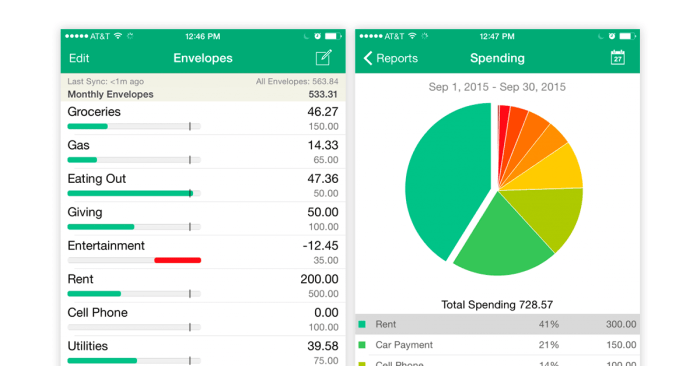
For example, an app might automatically categorize transactions based on merchant names, further streamlining the process. Mediocre apps often lack this crucial feature, requiring manual input of every transaction.Secondly, robust reporting and visualization capabilities are paramount. Top-tier apps provide detailed reports, charts, and graphs that clearly illustrate spending patterns across various categories, helping users identify areas of overspending.
These visualizations are far more insightful than simple lists of transactions, providing a clear picture of financial health. In contrast, less effective apps may offer only basic summaries, lacking the depth of analysis needed for effective budgeting.Finally, advanced budgeting tools are another defining characteristic. Effective apps allow users to set budgets for specific categories, track progress towards goals, and receive alerts when approaching budget limits.
This proactive approach empowers users to control their spending and avoid unexpected financial shortfalls. For instance, an app might send a notification when spending on entertainment exceeds the pre-set budget for the month, prompting users to adjust their spending habits accordingly. Simpler apps often lack these advanced features, offering only basic budget tracking functionality.
Top Expense Tracking Apps of 2024
Choosing the right expense tracking app can significantly simplify your financial management. This section highlights some of the leading apps available in 2024, comparing their features, pricing, and compatibility to help you make an informed decision. We’ll also delve into the unique aspects of a few top contenders and explore their user interfaces and experiences.
Top Expense Tracking Apps Comparison
A comprehensive comparison of features, pricing, and platform compatibility across several leading expense tracking apps is crucial for selecting the best fit for your needs. The following table provides a snapshot of five popular choices:
| App Name | Key Features | Pricing Model | Platform Compatibility |
|---|---|---|---|
| Mint | Budgeting, bill tracking, credit score monitoring, investment tracking | Free (with ads), Premium (subscription) | iOS, Android, Web |
| Personal Capital | Net worth tracking, investment management, retirement planning, budgeting | Free (basic), Premium (subscription) | iOS, Android, Web |
| YNAB (You Need A Budget) | Zero-based budgeting, goal setting, debt reduction tools | Subscription-based | iOS, Android, Web |
| PocketGuard | Spending analysis, budgeting, bill reminders | Free (limited features), Premium (subscription) | iOS, Android |
| Goodbudget | Envelope budgeting system, multi-user support, shared accounts | Free (limited features), Premium (subscription) | iOS, Android, Web |
Unique Selling Propositions of Top Apps
Each leading expense tracking app offers distinct advantages that cater to specific user preferences and financial goals. Three apps stand out for their unique selling propositions.
Mint excels in its comprehensive financial overview, combining expense tracking with credit score monitoring and investment tracking. This all-in-one approach simplifies financial management for users who want a single platform for various financial needs. Its integration with various financial institutions streamlines data aggregation, saving users time and effort.
YNAB (You Need A Budget) differentiates itself through its unique zero-based budgeting methodology. This approach encourages users to allocate every dollar to a specific purpose, fostering a more mindful and deliberate approach to spending. Its focus on goal setting and debt reduction makes it particularly appealing to users seeking financial clarity and control.
Personal Capital stands out with its robust investment tracking and financial planning features. Beyond basic expense tracking, it provides comprehensive net worth tracking, retirement planning tools, and investment management capabilities, making it a powerful tool for individuals with significant assets.
User Interface and User Experience of Popular Apps
The user interface and experience are crucial factors in determining app usability and overall satisfaction. Two popular apps illustrate contrasting approaches to user interface design.
Mint’s interface is known for its clean and intuitive design. The app presents data in a visually appealing and easily digestible manner. Navigation is straightforward, and key features are readily accessible. The overall user experience is designed for simplicity and ease of use, making it suitable for users of all technical skill levels.
YNAB, while equally functional, employs a more detailed and structured approach. Its interface reflects its zero-based budgeting methodology, with a strong emphasis on categorization and goal setting. While this might require a slightly steeper learning curve for some users, the structured approach can be highly effective for those who prefer a more organized and detailed budgeting system. The user experience prioritizes control and precision, catering to users who value a comprehensive and detailed overview of their finances.
Ultimately, the best expense tracking app for you depends on your individual needs and preferences. By carefully considering the features discussed, you can select a tool that seamlessly integrates into your life, empowering you to gain control over your finances and achieve your financial aspirations. Take the time to explore the options presented, and embark on your journey towards a more financially secure future.
Question Bank
What if I don’t have a bank account linked to the app?
Many apps allow manual entry of transactions, although automated syncing is more convenient. You can still effectively track expenses even without direct bank account integration.
How secure is my data with these apps?
Reputable apps employ robust security measures, including encryption and secure authentication. However, always check the app’s privacy policy and security protocols before providing sensitive financial information.
Can I use these apps for business expense tracking?
Some apps cater specifically to business needs and offer features like receipt scanning and reporting for tax purposes. Others may be suitable for simpler business expense tracking, but check their capabilities before using them for business purposes.
Are these apps free?
Many apps offer free plans with limited features, while premium subscriptions unlock advanced functionalities. The pricing models vary considerably, so compare options to find one that fits your budget.


